Your Body Builds Itself. But How Does It Know What to Make?
One cell. 37 trillion outcomes. Here’s the system running it all.
You started as one cell. Not a particularly special looking one either. Just a tiny sphere, sitting there, with no obvious signs that it was about to do something quite insane. Because from that one cell came a brain, a spine, two eyes in exactly the right place, ten fingers, and a heart beating on the correct side of your chest. The same outcome, repeated across every human who has ever existed. No mistakes and no mix-ups. Just a system so precise it borders on unbelievable.
So how does it actually work? How does a cell with no brain, no eyes, and no instruction manual handed to it from the outside know what to become?
That’s what we’re getting into today.
Every Cell Has the Same DNA. So Why Are They Different?
Every single cell in your body, from the neurons firing in your brain right now to the cells lining your stomach, carries the exact same genome. Same DNA and same instruction book. A skin cell and a liver cell are working from blueprints almost identical to one another. And yet they look completely different, behave completely differently, and do completely different jobs.
So if the instructions are the same, what’s making them different?
This was the core problem of developmental biology. And the answer involves two of the coolest systems in all of genetics. The first one is about where you are, while the second is about what you do with that information.
Your Body’s Chemical GPS
The first piece of the puzzle tells us that cells figure out where they are in the body using chemicals called morphogens. And the way morphogens work is quite elegant once understood.
Imagine pouring a drop of red dye into one end of a glass of water and leaving it. The end closest to the dye goes deep red. The middle fades to pink. The far end is barely tinted at all. You’ve just created a gradient. A smooth slide from high concentration on one end to almost nothing on the other.
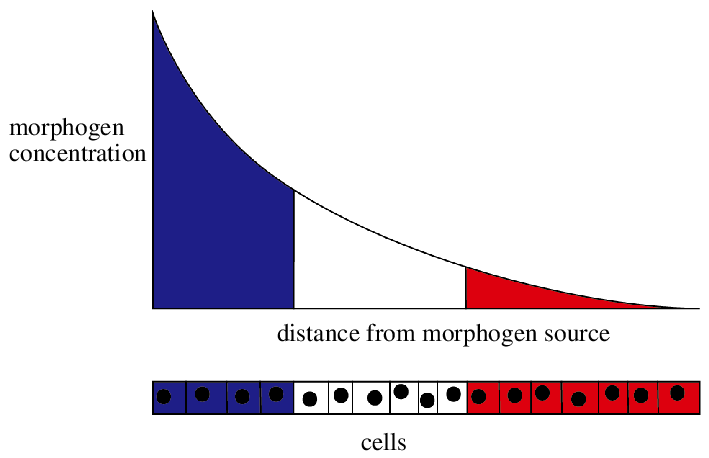
Now imagine that gradient happening inside a developing embryo. A signaling chemical gets produced at one end and diffuses outward. Cells close to the source are swimming in high concentrations of it. Cells further away see less and less. And every cell reads its local concentration like a dial and uses it to figure out its position. High concentration means one thing, medium means another, and low means something else entirely.
That dial is how your body draws a map of itself before it even has a body.
And no, this isn’t theoretical. In fruit flies, there’s a protein called Bicoid that does almost exactly this. It gets produced at the future head end of the egg and diffuses toward the tail end. Cells that detect high Bicoid develop into head structures and cells further away, seeing less of it, become the thorax and abdomen. And the part that makes it click: if you artificially mess up the Bicoid gradient, flies develop two tail ends instead of a head and a tail. The whole front half of the body just doesn’t happen, since the chemical map that tells cells “you’re the head end” was missing.
Your body is literally drawing itself in protein concentrations. That’s the GPS. And it works with a precision that genuinely shouldn’t be possible for something made of chemistry.
But What Do Cells Actually Do With That Information?
So now cells know where they are, but knowing your location isn’t enough. Something still needs to translate “you are here” into “you are going to be a leg” or “you are going to be an eye.” That translation is the job of Hox genes.
Hox genes are not the genes that actually build your body parts. They don’t construct a hand or wire up a retina. What they do is act like master switches that control which genes get turned on and where. They’re the foreman on a construction site who doesn’t lay a single brick but tells every worker what to build based on which floor they’re standing on. Floor one gets lobby instructions. Floor ten gets office instructions. Same workers, same materials, completely different outcomes depending on who’s giving the orders.
In your developing embryo, Hox genes read the positional information from morphogen gradients and use it to switch on the right building programs in the right places. Cells in the region that’s going to become your arm get a completely different set of active genes than cells in the region that’s going to become your head, even though both sets of cells started with identical DNA. Hox genes are what makes the difference.
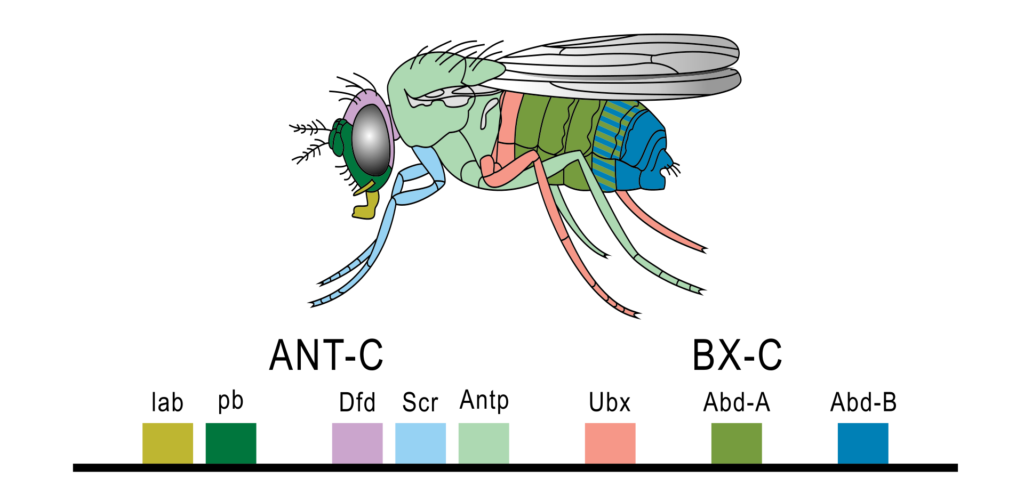
And here’s the thing: we all have them. Fruit flies have Hox genes. Mice have Hox genes. Sharks have Hox genes. Humans have Hox genes. And they’re not just vaguely similar across species. They’re arranged in the same physical order on the chromosome as the body parts they control, doing the same job, in almost every animal with a head and a tail. This pattern has been sitting there, unchanged, for over 500 million years of evolution. The master switches that help build your body are basically the same ones building a fruit fly.
The wildest demonstration of this comes from a mutation in fruit flies called Antennapedia. A single Hox gene malfunction causes the fly to grow fully formed legs where its antennae should be. Not stumps or random tissue. Actual, complete, functional legs. In the wrong place. The address system worked perfectly. The positional information was read correctly. But the wrong blueprint got sent to that location, and the cells followed it without question. That’s how powerful these switches are. And that’s how precise the system has to be to get it right every single time.
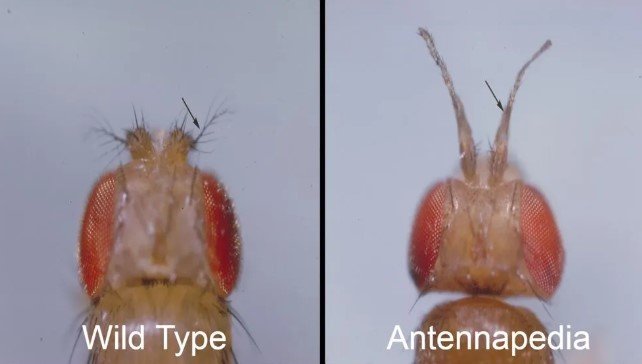
Right: a fly where one Hox gene misfired.
Those aren’t antennae.
One Cell. No Foreman. No Blueprint.
There is no architect overseeing your development. No external voice telling cell number 4,000 that it’s supposed to become part of your left retina and not your right kneecap. The whole system runs on chemistry and genetics talking to each other in a language that evolution has been refining for half a billion years.
Morphogen gradients draw the map. Hox genes read it and send out the orders. And from those two systems, working together in a cluster of cells too small to see with the naked eye, you get a brain and a spine and ten fingers and a heartbeat.
We’ve sequenced the human genome. We can edit DNA with CRISPR. We can grow miniature organs in a lab dish. And we are still reverse-engineering exactly how this works at every level. Every answer in developmental biology opens three more questions. Which honestly isn’t frustrating but rather proof that the system is deeper than we thought. And we already thought it was pretty deep.
One cell. 37 trillion outcomes. The same result, every time.
How does it know?
It reads the room. Literally.