How Blood Clots and Scabs Actually Work
The human body operates as a high-pressure plumbing system, continuously circulating about five liters of blood through thousands of miles of vessels. This closed loop maintains tight pressure to deliver oxygen and nutrients to every corner of the anatomy. Since it’s a pressurized system, it carries a glaring vulnerability: a single tear in the vessel lining means physics immediately takes over and if left unchecked, a minor puncture causes rapid drainage like a punctured garden hose.
Yet, biological systems refuse to let that happen. When a blood vessel breaks, an emergency system instantly kicks in, switching blood from a flowing liquid into a solid plug before the injury registers. Understanding survival through daily cuts and scrapes requires us to examine the multi-stage industrial operation that turns a catastrophic leak into a hardened, temporary patch.
Pressure Problem and the Broken Wall
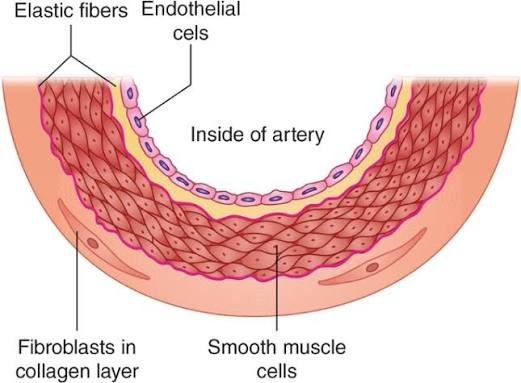
How blood vessels are built explains why a cut can become a real problem if it is ignored. The inside of every blood vessel is lined with a smooth, specialized layer of cells called the endothelium. This lining is chemically designed to be completely non-sticky, which lets red blood cells, white blood cells, and platelets slide past smoothly without any friction at all.
Right underneath this cell layer is a tough structural framework made mostly of collagen fibers. As long as the endothelial lining stays whole, blood never touches those fibers. But the moment you cut your skin, that protective layer is torn open, exposing the rough, jagged collagen underneath to the blood.
The fluid dynamics change the second a vessel wall breaks. The constant blood pressure driving your circulation immediately pushes fluid outward toward the tear, threatening rapid blood loss. At that exact moment, your body faces a tough double task: it has to build a plug instantly to stop the bleeding while keeping the chemical signals locked tight to the injury site.
This local control is critical because the chemicals that turn blood into a solid plug are extremely powerful. If those signals escape the wound and float freely into your main bloodstream, they will trigger a chain reaction everywhere. Instead of just sealing a tiny scratch on your finger, your body would start turning blood solid inside your veins, creating dangerous blockages in your heart, lungs, or brain. The body has to launch an emergency fix while making sure the chemical reaction stays contained entirely to the damage zone.
The Emergency Response and Platelets
The first responders to a breach are not white blood cells or antibodies, but platelets. Platelets are not even whole cells but rather small, irregularly shaped cell fragments, acting as microscopic disk-shaped blobs circulating in the blood by the millions, produced by larger cells deep inside the bone marrow.
When a vessel tears and those hidden collagen fibers are exposed, a specific protein floating in the blood called the von Willebrand factor acts as a molecular anchor, binding instantly to the exposed collagen. As platelets rush past the wound site, they catch on this von Willebrand anchor. Contact with the exposed collagen and anchor protein triggers a complete behavioral shift, transforming a smooth, inactive disk into a sticky, activated agent.
The platelet rapidly sprouts long, spiky arms called pseudopodia while releasing chemical signals, such as ADP and thromboxane A2, into the local environment to alert other platelets of the emergency. These chemicals force nearby passing platelets to activate, get sticky, and pile onto the initial cluster.
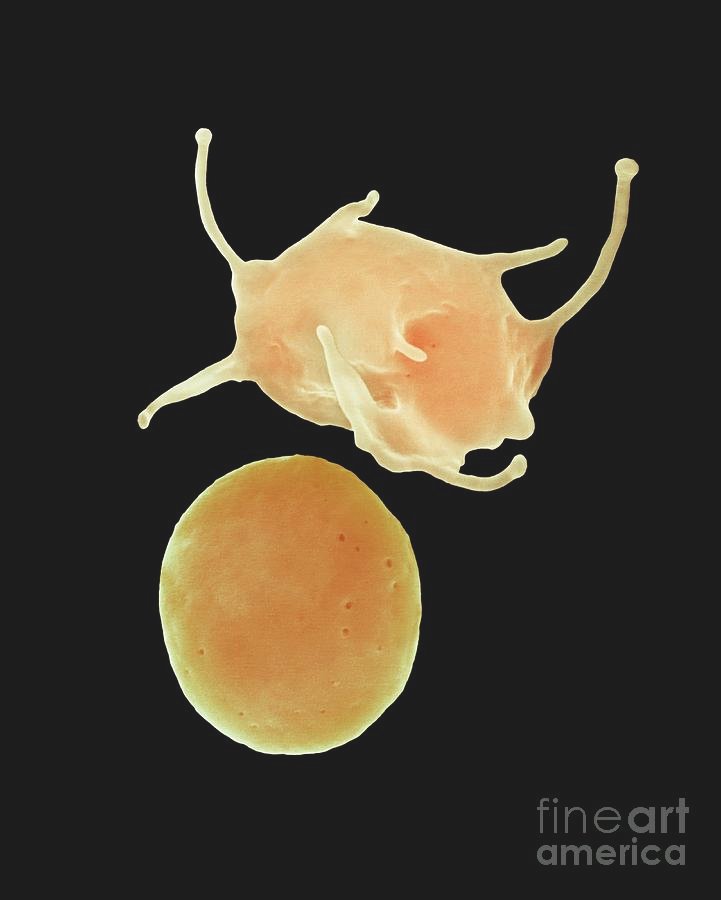
Non-activated platelets (bottom)
via FineArtAmerica
Within seconds, a primary platelet plug forms. A tangled mass of spiked, sticky platelets slams into the hole, drastically slowing down the bleeding. A major limitation remains because this initial plug is mechanically weak. Since blood pressure pushes hard against it, a simple clump of sticky cells blows right out like a bad patch unless something much stronger reinforces it.
(Note: If your body does not make enough of that von Willebrand anchor, or if the protein does not work right, your platelets miss their cue to catch on the wound. The next post will cover what happens when people lack this crucial protein.)
The Clotting Cascade
Turning that fragile pile of sticky platelets into a permanent, rock-solid wall requires launching a massive chemical chain reaction called the coagulation cascade.
Think of it like an emergency relay race happening inside your blood. The body uses a dozen different proteins floating around in your system, called clotting factors, and numbers them from Factor I to Factor XIII. They do not all jump into action at once. Instead, they act like a row of dominos. Factor one activates factor two, which activates factor three, and each step multiplies the strength of the signal.
This chain reaction can start in two different ways:
- Outside the vessel: Triggered quickly when tissue outside the blood vessel gets damaged.
- Inside the vessel: Triggered a bit more slowly when blood touches the rough, torn edges of a broken vessel wall.
No matter which way the alarm starts, both paths race toward the exact same final finish line: creating an enzyme called thrombin.
Once thrombin is unlocked, it acts as the master builder of the entire operation. It hunts down a dissolved protein floating in your blood called fibrinogen and cuts little pieces off of it. This chemical haircut instantly transforms the loose protein into long, sticky threads of fibrin.
These fibrin threads cross-link with each other over the platelet plug, forming a dense, microscopic net. Red blood cells get caught in this net like fish in a trap. This turns the loose pile of cells into a tough, rubbery blood clot that can handle the full pounding pressure of your cardiovascular system without blowing out.
Liquid to Hard Crust
Once the clot forms and successfully stops the bleeding, the exposed surface of the clot begins to dry out upon contact with the air. As moisture evaporates, the trapped red blood cells, platelets, and cross-linked fibrin mesh dehydrate, harden, and darken, transforming the surface layer into a scab.
Most of us view a scab as a simple, dirty crust, and treat it as an annoying leftover of an injury. In reality, that hard shield is a brilliant structural defense that acts as an impermeable physical barrier, sealing off the interior of the body from external bacteria, dirt, and pathogens floating around in the environment, keeping the sterile interior safe while actual repair work happens underneath.
The Underground Construction Site
While the hard crust protects the surface, a massive repair project gets to work directly beneath it. The moment the vessel tore, bacteria had a chance to sneak inside. To handle this, the body deploys specialized white blood cells called neutrophils and macrophages. These cells march straight into the wound to swallow up foreign bacteria, clear out dead tissue, and vacuum up leftover cellular trash before an infection can take root.
Once the area is clean, actual reconstruction begins. Specialized cells called fibroblasts migrate into the wound, moving along the sticky fibrin threads to lay down fresh tracks of collagen. They build a brand-new foundation from the bottom up. At the same time, surviving blood vessel cells start dividing and pushing out brand-new extensions to restore blood flow to the recovering tissue.
As new skin cells multiply and close the gap from underneath, they push upward and slowly separate the hard scab from the living tissue below. Once the barrier is fully restored, the body releases enzymes that dissolve the remaining anchor points. The scab naturally detaches, leaving behind a fresh patch of repaired skin.
Life essentially survives physical damage by maintaining an aggressive, high-speed emergency response that converts a leaking disaster into a reinforced fortress in a matter of seconds.