The Liquid Wall: Where the World Ends and You Begin
If we strip away the anatomy and the physiology, and take a look at what actually defines a living thing, we won’t get a collection of organs or a complex nervous system but rather, a boundary. And if you took all the machinery that makes you you, the proteins, the DNA, the enzymes, the metabolic engines, and you dumped them into a beaker of water, you wouldn’t get a living organism. You’d get a soup. A high-tech, biochemically complex, potentially reactive soup, but a dead one nonetheless.
To be alive, we must maintain an environment inside that is fundamentally different from the world outside. We are constantly fighting against the second law of thermodynamics, which dictates that everything in the universe naturally trends toward chaos and equilibrium. You are a localized pocket of extreme order, and the only thing holding the line is the cell membrane. The cell membrane is unarguably one of the most high-stakes, high-pressure border control systems known to mankind.
The Physics behind the liquid wall
Most of us have seen the diagram, a clean, double-layered row of circles with tails.
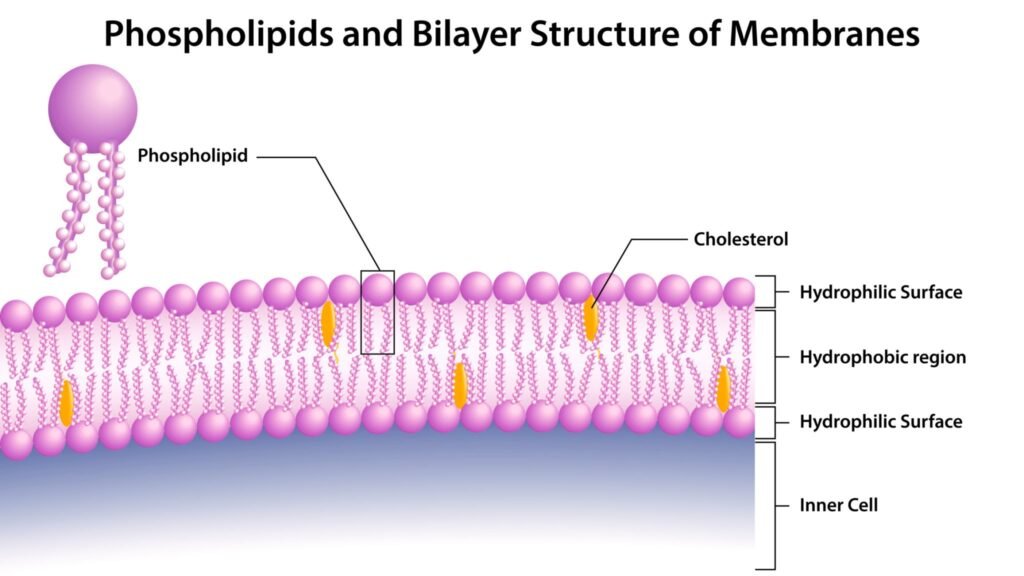
But that static, sanitized image is nothing more than a lie. The membrane is composed of phospholipids which are these molecules that are the fundamental oddity of biology: they are amphipathic, meaning they possess a head that loves water and a tail that is hydrophobic, thus, terrified of water. When these molecules are placed into the watery environment of your body, they don’t require an architect or a construction crew to build a barrier. They self-assemble. The hydrophobic tails instinctively turn away from the water, snapping together to form a hydrophobic core, while the hydrophilic heads face outward. It is not a solid wall but rather an oil slick. A two-dimensional liquid.
The entire structure is constantly, violently vibrating, bubbling, and folding in on itself and if you could zoom in and watch it in real-time, you wouldn’t see a static barrier. You would see a frantic, churning sea of molecules. And yet, this liquid is completely impermeable to almost everything. Whether you are a salt ion, a sugar molecule, or a water-soluble toxin, once you hit this oily middle, you stop dead and you cannot pass.
The Industrial Complex of the Mosaic
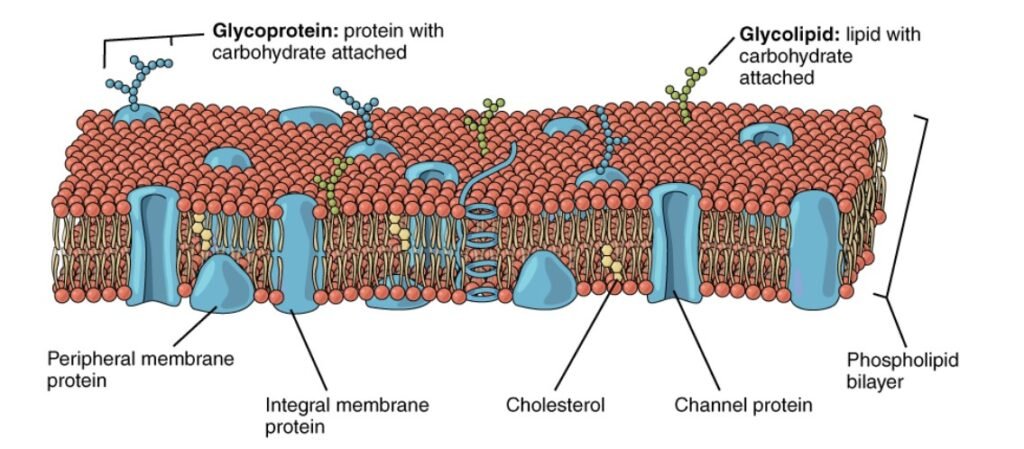
Because the membrane is a total lockout for anything that isn’t a lipid, the cell has to build doors making this the “mosaic” part. Embedded into this shifting sea of oil are thousands of massive, complex proteins which aren’t just decorative; they are the cellular equivalent of heavy industrial machinery, and they operate at speeds that are difficult to even conceptualize.
- The Pumps (Active Transport): This is where life becomes energetically expensive. Molecules naturally want to move from areas of high concentration to low concentration which is essentially entropy in action. But your cells often need to force molecules against that current to survive. Whether it’s to keep your neurons firing or your blood sugar balanced, your cell membrane is constantly running protein pumps that force molecules into the “wrong” space. These pumps are the most significant energy drain in your body. You are burning a massive percentage of your caloric intake just to keep these pumps running and without them, your cells would reach equilibrium with the outside world which in a biological sense, is death.
- The Channels (The Floodgates): Sometimes, you don’t have time for a pump, you need raw speed. For example, when a nerve impulse needs to travel down an axon, you need thousands of ions to shift in milliseconds. The cell uses protein channels; precision-engineered tunnels that snap open and closed at the speed of a fraction of a millisecond. When they open, molecules rush through by the millions, creating the electrical potential that allows you to think and move.
- The Sensors (The Receptors): The membrane is the cell’s only way of knowing the world exists. These receptors are effectively antennas, so when a hormone or a signal molecule bumps into one, the receptor undergoes a physical conformational change, it literally twists, transmitting a signal into the cell. It is a mechanical transmission of information that turns a chemical bump on the outside into a genetic shift on the inside.
The Constant War between Entropy and Engineering
A fundamental truth about cells is that they exist in a constant, low-level state of war against entropy as the universe perpetually attempts to pull biological structures apart. It wants the ions inside to leak out, the internal pressure to equalize with the external world, and the concentration gradients, the very things that allow hearts to beat and brains to fire, to eventually die out. The cell membrane acts as the thin, fragile frontline of that war, representing a barrier that remains leaky by design due to its liquid nature.
The membrane also exists as a two-dimensional fluid, making it constantly shift and vibrate, meaning those phospholipids are not locked in place but are instead dancing in a restless state. In that dance, tiny gaps momentarily open, allowing water to slip through the oily interior in a process called osmosis. This creates a relentless physical threat; if cells lacked a way to bail out that encroaching water, they would swell until they burst like an overfilled balloon. Consequently, cells must spend a significant amount of energy to physically pump that water out, making the cell essentially a biological submarine with a hole in the hull, where pumps must run around the clock just to prevent sinking.
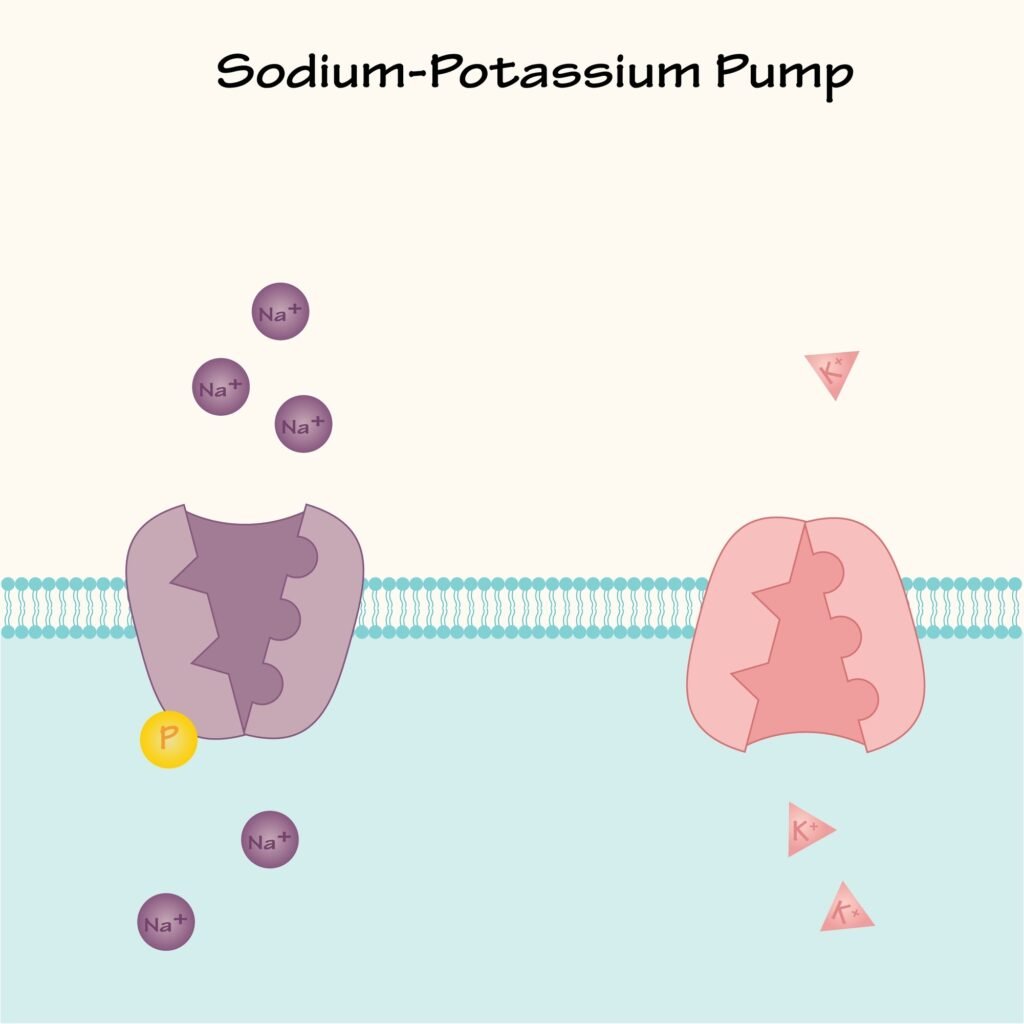
The struggle becomes truly intense as cells intentionally maintain a massive, unstable imbalance of ions, specifically sodium and potassium, to function. Inside the cell, potassium levels are kept high while sodium levels are kept low, but outside, the reverse is true, creating a biological battery primed for action. Nature absolutely hates this manufactured imbalance and constantly attempts to rush sodium in while pushing potassium out until everything is neutralized and the battery is dead.
This happens constantly, as sodium ions are always leaking back into the cell through those shifting lipid gaps, forcing cells to rely on a machine called the Sodium-Potassium Pump. This protein is a tireless workhorse that grabs sodium ions from the inside, kicks them out into the dangerous extracellular space, and pulls potassium back in, all while fighting against the natural flow of diffusion. It performs this duty using ATP, which is basically the cell’s energy currency; if the ATP supply drops, the pumps stop, the electrical charge collapses, and the cell dies. Life is not merely a static structure, but a dynamic, high-energy process maintained by a massive, continuous expenditure of energy and if that energy expenditure stops, the cellular identity simply dissolves into the surroundings.
The Vulnerability: Hacking the Gate
Because the membrane is the only entry point, it’s also the only way to get into the cell. And evolution has been playing an arms race here for billions of years. Viruses don’t just “break in.” They are master hackers that have evolved proteins on their surface that perfectly mimic the specific “keys” your cell’s receptors are programmed to recognize. They trick the membrane, acting like a VIP visitor, until the cell itself pulls them inside and once the cell opens that door, the game is over.
Even our own medicine is just a form of hacking. When you take a medication, whether it’s for heart disease, anxiety, or pain, you are almost always introducing a molecule designed to interact with a specific membrane protein. You are effectively trying to plug a hole, block a receptor, or force a pump to work faster, thus hacking your own membrane to try and reset the balance of your internal chemistry.
Every single second, cells are performing these complex molecular exchanges millions of times over, and with 37 trillion cells working in unison, the sheer scale of this self-repairing, signal-processing industrial operation is nearly impossible to visualize. The next time life involves something as simple as breathing, eating, or sitting still, it is worth remembering that a body is not merely a single unit, but rather a massive, organized collection of 37 trillion independent trade hubs, each fighting a never-ending battle to maintain its own internal identity against the chaos of the outside world.
Ultimately, the cell membrane is far more than a simple container or a passive skin; it is the fundamental reason that life exists as a distinct entity rather than a disorganized puddle of chemicals, serving as the essential, high-energy border that defines where the world ends and a living individual begins.